
Automation Specialist
1 Week
Content Automation
n8n, AI Agent, API, Webhook, etc
Creating and publishing social media content was a manual and fragmented process for the client. Articles needed to be reviewed, LinkedIn posts drafted, approvals requested through multiple messages, and publishing handled manually.
The challenge was not generating content. The challenge was managing the delays and coordination that happened between content creation and approval.
While AI could significantly accelerate content generation, removing human oversight entirely would introduce a new risk: unapproved content being published under the company’s brand.
The objective was to design a workflow that reduced the operational effort involved in content publishing while maintaining complete human control over what ultimately went live.
Before building the automation, I mapped the existing content publishing process to identify bottlenecks and unnecessary waiting periods.
The analysis revealed that content creation itself was relatively quick. Most delays occurred during review, approval, and publishing coordination. This insight shaped the architecture of the solution.
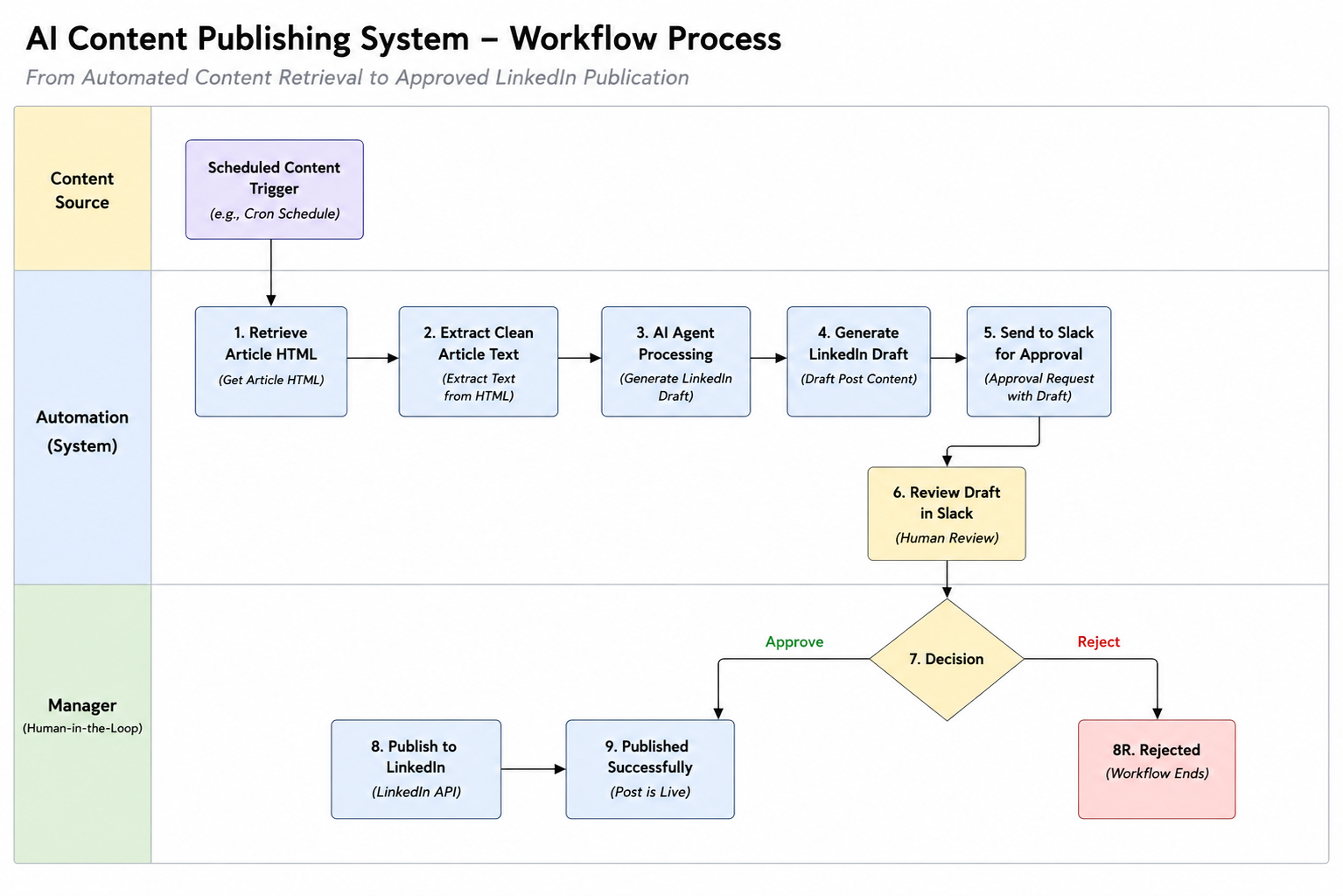
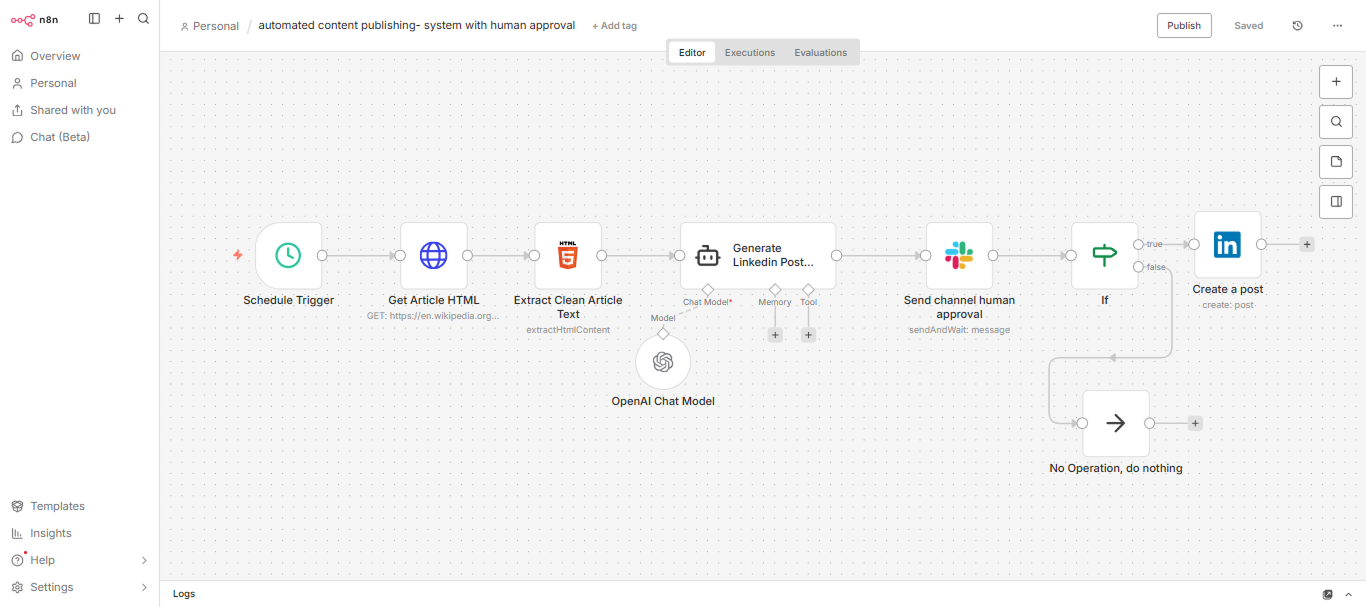
The workflow begins with a scheduled trigger that automatically retrieves an article from a predefined source.
Before any AI processing occurs, the system extracts the clean article content from the page HTML and removes irrelevant elements such as navigation components, page structure, and formatting noise.
This preprocessing stage ensures the AI works with meaningful content rather than raw webpage markup.
Before touching the workflow I spent time with the client documenting their brand voice: sentence length, formality level, hook types, and topics they consistently avoided. That briefing went into the AI Agent’s system prompt. The Agent read the submitted article URL, drafted a post in the client’s voice, and produced output ready for review rather than output that needed rewriting before it could be considered.
The cleaned article content is sent to an AI Agent configured to generate professional LinkedIn posts.
Rather than simply summarizing the article, the Agent is instructed to produce publication-ready content aligned with the client’s preferred communication style and audience expectations.
The goal was not to eliminate human review, but to reduce the effort required to create an initial draft.
The most important component of the solution is the approval layer.
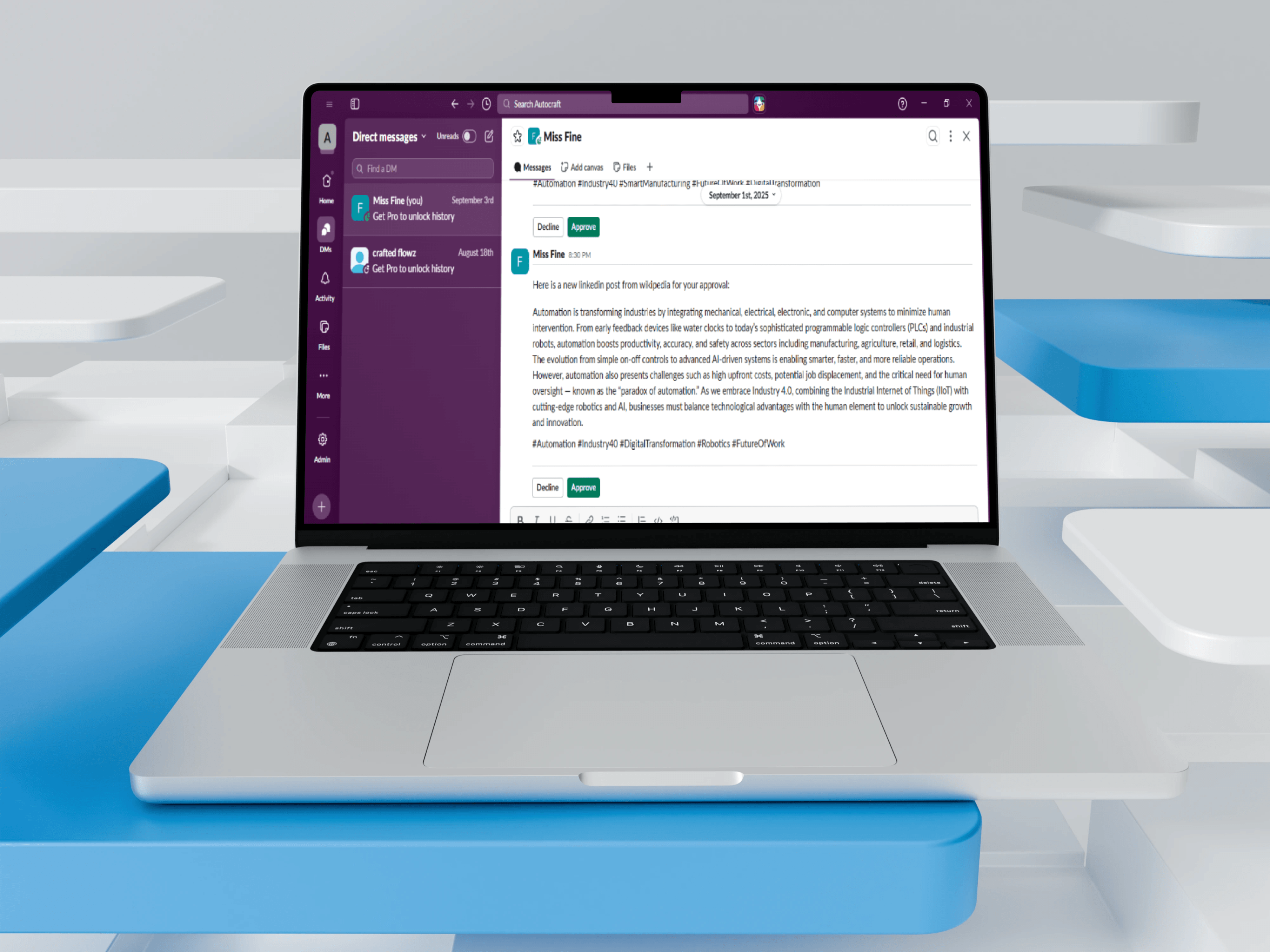
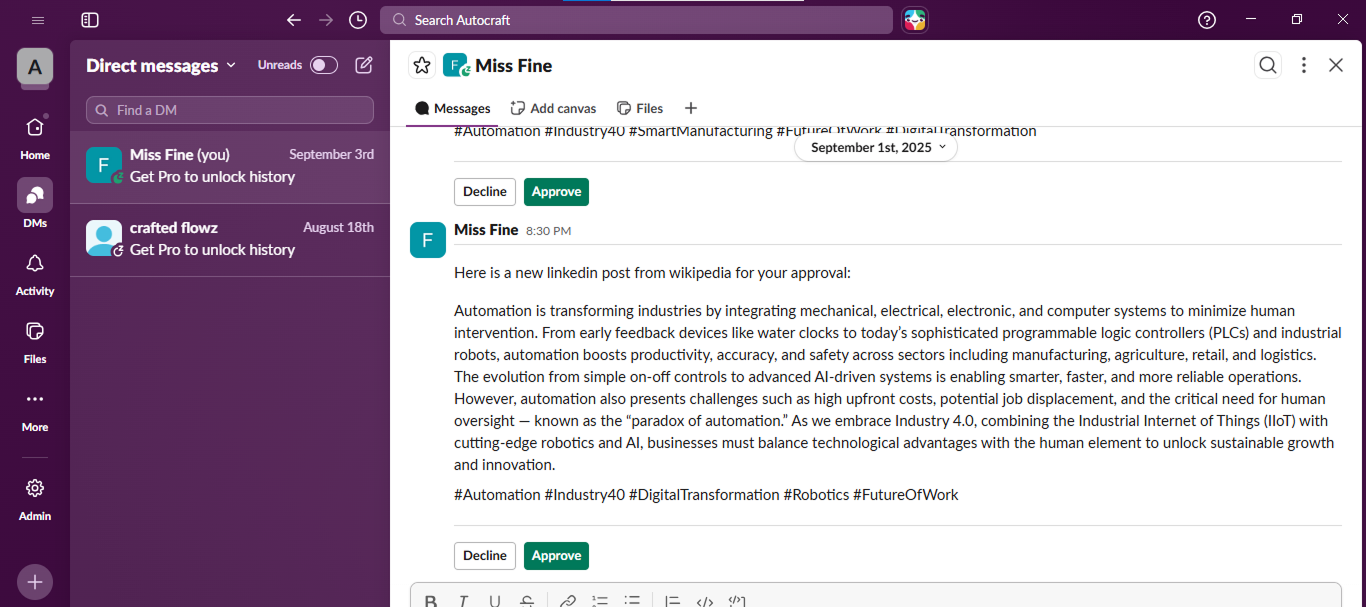
Instead of publishing automatically, the generated draft is sent directly to a designated Slack channel where decision-makers can review the content.
At this point, the workflow pauses and waits for a response.
A manager can either approve or reject the draft using Slack’s interactive controls. Only after an approval is received does the workflow continue.
This approach combines the speed of AI-generated content with the governance and accountability of human oversight.
When a draft is approved, the workflow automatically publishes the content to LinkedIn through the LinkedIn API.
If the draft is rejected, the workflow terminates without publishing, ensuring that no content can reach production without explicit authorization.
The fastest solution would have been fully automated publishing.
I intentionally rejected that approach.
The purpose of the system was not to remove human involvement entirely but to eliminate repetitive work while preserving accountability. Human approval remained a mandatory checkpoint because brand reputation carries significantly more risk than delayed publication.
Many AI workflows pass raw webpage content directly into the model.
I introduced a dedicated extraction stage that isolates the actual article text before generation begins. This improves output quality by reducing noise and ensuring the AI focuses only on relevant content.
The approval experience was designed around simplicity.
Reviewers receive the draft and approval controls directly inside Slack without needing to open additional systems or dashboards.
By reducing the number of actions required to make a decision, approval times decreased dramatically.
The solution transformed a fragmented manual process into a streamlined content publishing workflow.
Active effort spent on content creation and scheduling was reduced by more than 90%, while approval decisions that previously took hours or days could now be completed in seconds directly within Slack.
Most importantly, the organization maintained complete control over what was published. Every post required explicit human approval before reaching LinkedIn, ensuring 100% oversight and brand safety.
The result was a scalable content operation that combined AI-driven efficiency with human-led governance.
Average Approval Time
Time Saved
Human Approval Control
Unauthorized Publications
The next evolution of the workflow would introduce an automated revision loop.
Instead of ending the process after a rejection, the system could collect reviewer feedback, pass that feedback back to the AI Agent, generate a revised draft, and return it to Slack for another approval cycle.
This would create a complete review-and-revision framework while maintaining the same governance controls that make the current solution effective.
If I returned to this project, I would push for usability testing specifically on the two-sided onboarding flows: the moment where a new user self-selects as a job seeker or recruiter and enters their respective experience for the first time. Over 16 weeks I designed extensively for what happens after that decision, but I validated the onboarding sequence primarily through stakeholder review rather than with real users. The stakes at onboarding are high: a job seeker who misunderstands the CV builder in the first two minutes will not complete it, and a recruiter who can’t find their pipeline on day one will not return. Testing that critical first five minutes with both user types would have either confirmed the current approach or surfaced drop-off points I couldn’t have anticipated from the inside.
What this project built in me was a sharper instinct for two-sided product design: the discipline of asking, for every single screen, which user is looking at this and what do they need to be able to do next.
That is exactly where I do my best work. Tell me what is frustrating you operationally, even if you cannot name it precisely yet. I will ask the right questions and tell you what I would fix first.